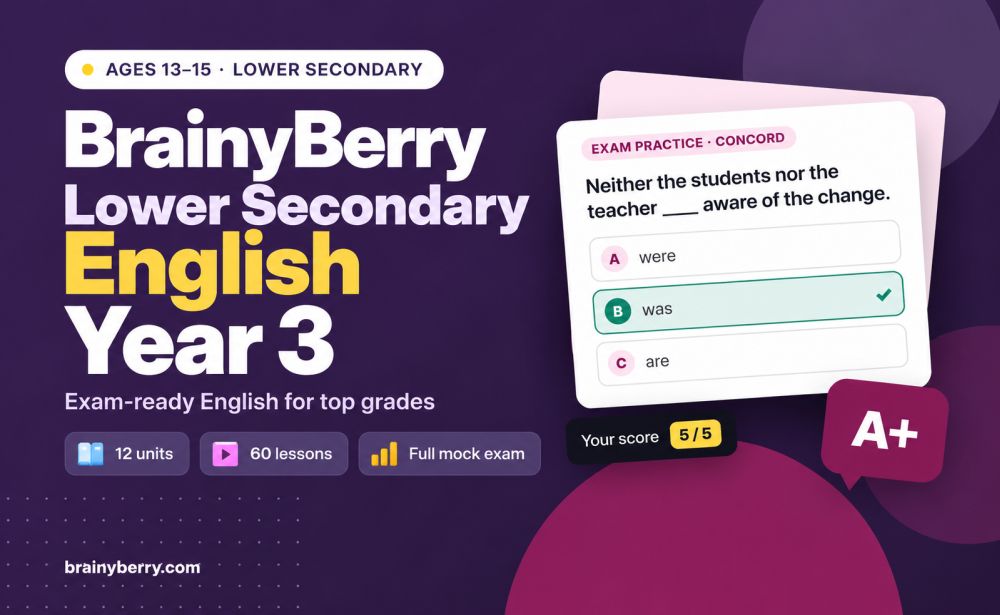
Lower Secondary English — Year 3

Uncategorized
Wishlist Share

About Course

Essential English, Year 3: Exam-ready English. Sharpen every skill, master every paper, walk in with confidence.

This is the year it all comes together. Year 3 turns everything you’ve learned into exam-winning performance. You’ll get the techniques top scorers use, the habits that stop careless mark loss, and a full mock exam so the real one holds no surprises.

Across 12 units and 60 focused lessons (10–15 minutes each), you’ll master:

  • Grammar and usage: all 12 tenses, every conditional, tricky concord, question tags and the errors that cost the most marks
  • Reading and comprehension: unseen passages, words in context, tone, purpose, and grammatical name and function
  • Summary: finding key points, paraphrasing and writing concisely
  • Literature: reading poems and drama, theme, technique and PEEL paragraphs that prove your point
  • Writing: narratives, essays, speeches, articles, reports, formal letters and minutes, all under timed conditions

Every lesson follows the same proven path: hook, learn, worked examples, practise, apply, and an exit quiz. You’ll see answers at three levels of quality, so you know exactly what top marks look like. Then put it all to the test in a full mock examination and a final revision unit.

Aligned with Cambridge Lower Secondary Checkpoint (Stage 9), UK Key Stage 3 (Year 9) and GCSE preparation, US Common Core (Grade 8) and BECE/WAEC. That makes it ideal for learners aged 13–15 anywhere in the world.

Start Year 3 today, and make exam day the day you shine.

Excerpt: Turn your English into exam-winning performance with 60 focused lessons, timed practice, model answers at three levels and a full mock exam, built for learners aged 13–15 worldwide.

Show More

What Will You Learn?

  • Use all 12 tenses accurately and keep the sequence of tenses consistent
  • Master second, third and mixed conditionals, wishes and "unless"
  • Apply tricky concord rules, question tags and correct word order under exam pressure
  • Choose words nearest or opposite in meaning and interpret idioms and phrasal verbs
  • Answer any comprehension question type with a clear, reliable reading method
  • Explain words in context, tone, purpose, and grammatical name and function
  • Write accurate summaries by finding key points and paraphrasing concisely
  • Analyse poems and drama: figurative language, sound, structure, character and theme
  • Write PEEL paragraphs that prove your point about literature and set texts
  • Write compelling narratives, balanced essays, speeches, articles and reports
  • Write formal letters of complaint and request, letters to the editor and minutes
  • Plan, time and proofread your writing to finish strong in every exam
  • Spot and fix the grammar, spelling and punctuation errors that lose the most marks
  • Mark your own work like an examiner and turn mock scores into clear targets

Course Content

Unit 1: Tenses, Memoir and Narrative: Your Story, Your Voice
Unit overview By the end of this unit, students can use the full English tense system accurately, keep tenses in sequence, avoid common confusable words, read a memoir critically and write a personal narrative under time. The theme is identity and heritage: the people, places and traditions that make us who we are. The unit has five lessons of 10–15 minutes, a unit test with a timed writing task, and original model texts. These skills are tested in every lower-secondary system: • BECE and other WAEC papers: Lexis and structure (tenses, sequence of tenses), oral English (consonant clusters), comprehension and narrative composition • Cambridge Lower Secondary and IGCSE: Tense accuracy in writing; reading non-fiction for the writer's attitude; narrative and descriptive writing • UK Key Stage 3, preparing for GCSE: Evaluating a writer's methods; writing to describe and narrate; spelling of commonly confused words • US Grades 6–8 (Common Core): Verb forms and avoiding inappropriate shifts (Language standards L.8.1); analysing an author's point of view; writing narratives with descriptive detail Students will be able to: • use all twelve tenses and the main future forms, and choose between them by meaning • keep tenses in sequence after past reporting verbs and in time clauses • tell apart commonly confused words (affect/effect, lose/loose, principal/principle and others) and say consonant clusters clearly • answer literal, inferential and evaluative questions on a memoir using Point-Evidence-Explain • plan and write a personal narrative in 40 minutes, showing rather than telling All texts are original and written for this course. British spelling is used; US variants are noted where they differ.

Unit 2: Conditionals, Evidence and Essays: Argue Like an Expert
Unit overview By the end of this unit, students can use every type of conditional, write in a formal academic register, judge the evidence behind claims in the news and write both one-sided and balanced argument essays. The theme is global challenges: climate, waste, transport, health and technology. The unit has five lessons of 10–15 minutes, a unit test with a timed essay, and original model texts. These skills are tested in every lower-secondary system: • BECE and other WAEC papers: Lexis and structure (conditionals, wishes), comprehension and argumentative or expository essays • Cambridge Lower Secondary and IGCSE: Argumentative and discursive writing; reading non-fiction for evidence and bias; complex sentence structures • UK Key Stage 3, preparing for GCSE: Writing to argue and persuade; evaluating how writers use evidence; formal vocabulary and Standard English • US Grades 6–8 (Common Core): Arguments with claims and counterclaims (W.8.1); evaluating reasoning and evidence (RI.8.8); conditional and subjunctive mood (L.8.1) Students will be able to: • form and choose zero, first, second, third and mixed conditionals, and use unless, provided that and wish • replace everyday words with precise academic vocabulary, use word families and hedge claims • tell fact from opinion, judge the reliability of sources and work out percentage changes • recognise when a claim confuses correlation with cause • plan and write one-sided and balanced argument essays with PEEL paragraphs in 40 minutes All texts are original and written for this course; the news article, its city and its figures are invented for practice. British spelling is used; US variants are noted where they differ.

Unit 3: Character, Theme and Analysis: Inside the Story
Unit overview By the end of this unit, students can analyse character, theme and narrative technique in prose fiction, write a literary response with PEEL paragraphs, and study a set novel efficiently. Two grammar lessons (participle phrases and sentence variety) give them the tools to discuss, and use, a writer's sentence choices. The unit has five lessons of 10–15 minutes, a unit test on an unseen extract, and original texts. These skills are tested in every lower-secondary system: • BECE and other WAEC papers: Literature questions on prose set texts (character, theme, techniques); lexis and structure; composition • Cambridge Lower Secondary and IGCSE: Responses to unseen and set prose extracts; analysis of language and structure • UK Key Stage 3, preparing for GCSE: Analysing how writers use language and structure; responding to a novel with textual evidence • US Grades 6–8 (Common Core): Citing textual evidence (RL.8.1); theme (RL.8.2); how incidents reveal character (RL.8.3); point of view (RL.8.6); participles and other verbals (L.8.1) Students will be able to: • use present, past and perfect participle phrases correctly and avoid dangling participles • vary sentence type, length and opening for effect, and avoid comma splices • analyse direct and indirect characterisation and work out word meanings from context • identify theme, viewpoint, setting, symbol, flashback and foreshadowing and explain their effects • write a literary response with PEEL paragraphs and embedded quotations, and keep a study log for a set novel The story "The Red Kite" and the extract "The Recital" are original and written for this course. Teachers can apply every lesson to their own set novels. British spelling is used; US variants are noted where they differ.

Unit 4: Letters, Minutes and Presentations: Sound Professional
Unit overview By the end of this unit, students can report questions and commands accurately, control register and tone, write formal letters of complaint and request, write letters to the editor and minutes of a meeting, and give a formal presentation. These are the skills of school, work and public life. The unit has five lessons of 10–15 minutes, a unit test with a timed formal letter, and original model texts. These skills are tested in every lower-secondary system: • BECE and other WAEC papers: Formal letters (complaint, request, to the editor); reported speech in lexis and structure; oral English • Cambridge Lower Secondary and IGCSE: Directed writing in formal registers; speaking tasks; reported speech in writing • UK Key Stage 3, preparing for GCSE: Writing for formal purposes and audiences; formal presentations (GCSE Spoken Language) • US Grades 6–8 (Common Core): Writing suited to task, purpose and audience (W.8.4); presenting with eye contact, volume and clear pronunciation (SL.8.4); using multimedia in presentations (SL.8.5) Students will be able to: • report yes/no and wh- questions, commands and requests, and use reporting verbs such as advise, remind and suggest • choose a formal register and a polite but firm tone, using softeners and impersonal phrases • write formal letters of complaint and request with correct layout, facts and a specific request • write a letter to the editor and the minutes of a meeting with clear action points • plan and deliver a formal presentation with signposts, effective slides and confident delivery All texts are original and written for this course; names, organisations and figures are invented. British spelling and letter conventions are used; US variants (such as "Sincerely") are noted.

Unit 5: Summary: Say More with Less
Unit overview By the end of this unit, students can summarise a passage accurately, in their own words and within a set limit, in either of the two formats exams use. The unit has five lessons of 10–15 minutes, a 25-minute unit test, and keys with model answers. Summary is tested far beyond the BECE, so the unit is written for all of these: • BECE and other WAEC papers: A set number of points, often one sentence for each • Cambridge Lower Secondary and IGCSE: A paragraph within a word limit, in your own words • UK Key Stage 3, preparing for GCSE: Summarising and comparing information from texts • US Grades 6–8 (Common Core): An objective summary of a text's central ideas Students will be able to: • tell main ideas apart from supporting details and examples • pick out exactly the points a question asks for • paraphrase accurately, including replacing lists with general words • cut padding and repetition to meet a word limit • write a complete summary as numbered sentences or as a paragraph Each lesson follows the standard template: hook, learn, worked examples, practise (10 auto-marked items), apply (a short writing task with a model answer) and a five-item exit quiz. Lessons 2 and 5 are built around a short passage that stays on screen while students answer. Instruction used in this unit. For multiple-choice items, choose the option lettered A to D that best answers the question. All passages are original and written for this course.

Unit 6: Lexis and Structure: Grammar at Speed
Unit overview By the end of this unit, students can answer grammar and vocabulary multiple-choice questions accurately at exam speed, in about 45 seconds an item. They apply the trickiest concord rules, form question tags and use correct word order (including inversion), choose words nearest or opposite in meaning from context, interpret idioms and phrasal verbs, and spot the errors that lose the most marks. The theme is “Lexis and structure”: the small choices that win or lose marks. The unit has five lessons of 10–15 minutes, a 25-minute unit test, and answer keys with feedback. These skills appear in every lower-secondary English course and exam: BECE and other WAEC papers: Objective test (lexis and structure: concord, question tags, nearest meaning, opposites, idioms and phrasal verbs) Cambridge Lower Secondary Checkpoint (Stage 9): Grammar and vocabulary in context; accurate Standard English UK Key Stage 3 (Year 9) and GCSE preparation: Spelling, punctuation and grammar; vocabulary in context US Grade 8 (Common Core): Grammar and usage conventions (L.8.1); vocabulary in context (L.8.4); figurative language and word relationships (L.8.5) Students will be able to: apply the tricky concord rules examiners test most often form question tags correctly and use standard word order, including inversion choose the word nearest in meaning or opposite in meaning from context interpret common idioms and phrasal verbs spot and correct the most frequent mark-losing errors All items are original and written for this course. British spelling is used; US variants are noted. Instruction used in this unit. For multiple-choice items, choose the option lettered A to D that best completes the sentence or answers the question. The word or phrase being tested is shown in bold; in the platform it can appear underlined, as in the exam.

Unit 7: Poetry and Drama in Depth
Unit overview By the end of this unit, students can read an unseen poem or drama extract, identify how it works, and write a clear analytical paragraph about it. The unit has five lessons of 10–15 minutes, a 25-minute unit test, and keys with model answers. These are the literature skills every lower-secondary exam tests, whatever the set texts: • BECE and other WAEC papers: Literary terms, devices and questions on poetry, prose and drama • Cambridge Lower Secondary and IGCSE: Unseen extracts and analytical responses • UK Key Stage 3, preparing for GCSE: Analysing language, structure and form; writing analytical paragraphs • US Grades 6–8 (Common Core): Theme, figurative language, structure, and citing textual evidence Students will be able to: • identify a poem's subject, speaker, tone, mood and theme • name figurative language and sound devices and explain their effect • describe structure and form, including rhyme schemes and stanza types • read a drama extract, including stage directions, asides and dramatic irony • write a PEEL paragraph that analyses a technique with evidence Texts used. Every text is either in the public domain or written for this course, so it can be reproduced in full: Christina Rossetti, William Wordsworth, Robert Louis Stevenson, Emily Dickinson, Paul Laurence Dunbar and William Shakespeare, plus an original drama scene and an original unseen poem for the test. If your students study set texts that are still under copyright, the skills here transfer to them directly; the course teaches the method rather than reproducing the texts. Instruction used in this unit. For multiple-choice items, choose the option lettered A to D that best answers the question.

Unit 8: Speeches, Articles and Reports: Write for Real Readers
Unit overview By the end of this unit, students can write a speech, an article and a report that suit their purpose and audience, plan them in five minutes, and finish them on time. The unit has five lessons of 10–15 minutes, a unit test with a timed writing task, and annotated model answers. Writing for a purpose and an audience is tested in every lower-secondary system: • BECE and other WAEC papers: Composition: speeches, articles, reports and letters • Cambridge Lower Secondary and IGCSE: Directed and extended writing for a given audience and form • UK Key Stage 3, preparing for GCSE: Writing to inform, explain, argue and persuade • US Grades 6–8 (Common Core): Argumentative and informative writing for task, purpose and audience Students will be able to: • identify the purpose, audience and form of any writing task and choose the right register • write a speech using greetings, rhetorical devices and a call to action • write an article with a headline, an engaging opening and a memorable ending • write a formal report with headings, findings and recommendations • plan, write and proofread a piece of writing within a time limit How writing is marked. Most exam boards judge writing on four things, and every model answer in this unit is annotated against them: • Content: Relevant, well-developed ideas that answer the task • Organisation: The conventions of the form, clear paragraphs, linking words • Expression: Varied vocabulary and sentences, the right register • Accuracy: Grammar, spelling and punctuation All model texts are original and written for this course.

Unit 9: Comprehension: Read Smart, Answer Right
Unit overview By the end of this unit, students can recognise every common comprehension question type and answer each one accurately, in their own words, for full marks. The unit has five lessons of 10–15 minutes, a 30-minute unit test on an unseen passage, and a full answer key. Comprehension is the core of every reading paper, and the question types are much the same everywhere: • BECE and other WAEC papers: Literal and inferential questions, own-word answers, replacing words as used in the passage, figurative expressions, grammatical name and function • Cambridge Lower Secondary and IGCSE: Explicit and implicit meaning, vocabulary in context, writer's effects • UK Key Stage 3, preparing for GCSE: Retrieval, inference, language analysis, evaluation • US Grades 6–8 (Common Core): Citing evidence, inference, word meaning in context, author's purpose Students will be able to: • identify the type of each question and what it requires • answer in complete sentences and their own words, matched to the marks • replace a word with one of the same class and form, as used in the passage • explain figurative expressions, tone, character and the writer's purpose • give the grammatical name and function of a clause or phrase The passage. Lessons 1–5 share one original passage, "The Last Bus", so students can focus on the question types rather than a new text each time. The unit test uses a second, unseen passage. Both are written for this course. Instruction used in this unit. For multiple-choice items, choose the option lettered A to D that best answers the question.

Unit 10: Composition: From Good to Top Marks
Unit overview By the end of this unit, students can find and fix the 20 errors that cost most marks in compositions, raise the quality of their vocabulary and sentences, and judge their own writing against the same criteria examiners use. The unit has five lessons of 10–15 minutes, a 25-minute unit test, and a timed composition task that students mark themselves. Every exam that includes extended writing rewards the same things: • BECE and other WAEC papers: Content, organisation, expression and mechanical accuracy in compositions and letters • Cambridge Lower Secondary and IGCSE: Content, structure, style and accuracy in directed and extended writing • UK Key Stage 3, preparing for GCSE: Communication, organisation, vocabulary and sentence variety, and technical accuracy • US Grades 6–8 (Common Core): Clear development and organisation, precise language, and command of conventions Students will be able to: • spot and correct the ten most common grammar errors in their writing • spot and correct the ten most common spelling, punctuation and confusable-word errors • replace weak words with precise ones, and show rather than tell • see what separates a developing answer from a good and an excellent one • mark their own writing with a four-criterion rubric and set a clear target The four criteria used throughout: • Content: Relevant ideas that answer the task, developed with detail • Organisation: The conventions of the form, clear paragraphs, logical order, linking words • Expression: Precise vocabulary, varied sentences, the right register • Accuracy: Grammar, spelling and punctuation All model answers and example sentences are written for this course.

Unit 11: Mock Exams: Exam Day, Rehearsed
Unit overview This unit gives students two full mock papers in the format of the BECE English paper, taken under timed conditions, plus the preparation and review lessons around them. The format follows the 2025 and June 2026 BECE papers; every question and passage is original. • Paper 1: Objective: Time: 45 minutes · Structure: Part A, Lexis and Structure: Section A (Q1–15) sentence completion, including reported speech and the passive; Section B (Q16–20) nearest meaning; Section C (Q21–25) idioms; Section D (Q26–30) opposites; Section E (Q31–35) cloze passage. Part B, Oral English (Q36–40): consonant and vowel sounds, intonation · Marks: 40 • Paper 2: Theory: Time: 1 hour · Structure: Part A, Writing: one question from three, about 250 words (30 marks). Part B, Reading: comprehension passage (20 marks). Part C, Literature: short questions on extracts (10 marks) · Marks: 60 Who it serves. The paper is a demanding, all-round test of English, so the mock is useful well beyond the BECE: it practises grammar and usage, vocabulary in context, idioms, pronunciation, extended writing, comprehension and literary analysis, which together cover what WAEC, Cambridge Lower Secondary, UK Key Stage 3 and US middle-school assessments test. Literature. The real BECE Part C uses prescribed set texts, which are under copyright. The mock tests the same skills (literary devices, genre, speaker, mood, drama conventions) on public-domain and original extracts. BECE candidates should also revise their prescribed anthology. How to run the mock. 1. Lessons 1 and 2 first: the paper's format and strategy, then a short course in oral English, which the rest of Year 3 does not cover. 2. Paper 1 in one sitting, using the 45-minute timer on the lesson page (students can pause it or reset it to 45:00). Answers are hidden until the student submits; the page then marks each section. 3. Paper 2 in one sitting of one hour, written by hand or typed into the page, then marked with the scheme. 4. Lesson 5 last: review the results, keep an error log, set targets.

Unit 12 · Final Revision
Unit overview This is the last unit of Essential English. It uses what students learned from their mock exams in Unit 11 to target the final weak spots: the grammar points that lose the most marks, a final vocabulary bank, one last unseen passage with every question type, a final timed essay and a clear plan for exam day. The unit has five lessons of 10–15 minutes and a final unit test with a timed essay. All passages and models are original. The unit prepares students for: • BECE and other WAEC papers: Objective test (concord, question tags, idioms, phrasal verbs, confusables), comprehension (grammatical name and function, replacing words) and composition • Cambridge Lower Secondary Checkpoint: Reading fiction and non-fiction, grammar and vocabulary in context, and extended writing in different forms • UK Key Stage 3 and GCSE preparation: Reading unseen fiction, language analysis, transactional writing under timed conditions • US Grades 8–9 (Common Core): Conventions (L.8.1–2), figurative language and word relationships (L.8.5), reading literature (RL.8.1–4) and argument and informative writing (W.8.1–2) Students will be able to: • correct the grammar errors that lose the most marks at exam speed • use confusables, idioms, phrasal verbs and formal vocabulary accurately • answer every type of comprehension question on an unseen passage, including grammatical name and function • choose, plan and write a timed essay in the right form • follow a clear plan for the week before, the night before and the day of the exam British spelling is used; US variants are noted.