

Lower Secondary English — Year 2
About Course
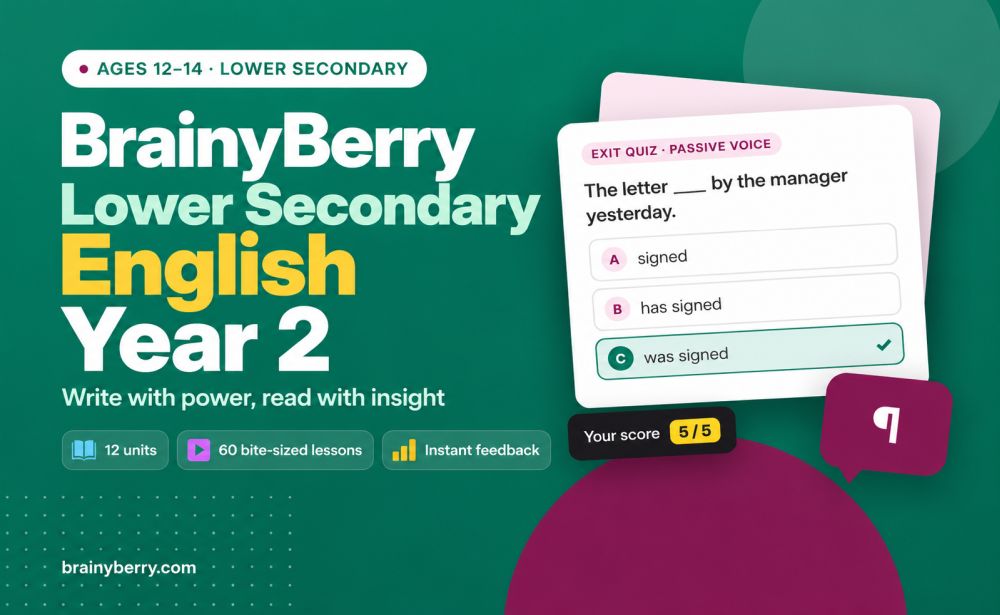
Essential English, Year 2: From good to great. Write with power, read with insight, speak with purpose.
You’ve got the basics. Now it’s time to make your English work harder for you. Year 2 takes you beyond correct English to effective English: sentences that flow, arguments that persuade and stories that keep readers on the edge of their seats.
Across 12 units and 60 bite-sized lessons (10–15 minutes each), you’ll master:
- Grammar: the passive voice, conditionals, relative and adverbial clauses, gerunds, reported speech and nominalisation
- Vocabulary: Latin and Greek roots, connotation, phrasal verbs, idioms and register
- Reading: myths, poetry, persuasive texts, adverts, explanations and suspense fiction
- Writing: formal letters, applications, speeches, leaflets, summaries, arguments and suspense stories
Every lesson follows the same proven path: hook, learn, worked examples, practise, apply, and an exit quiz. Instant feedback shows you what to fix. Unit tests and a full end-of-year exam prove how far you’ve come.
Aligned with Cambridge Lower Secondary (Stage 8), UK Key Stage 3 (Year 8), US Common Core (Grade 7) and BECE/WAEC. That makes it ideal for learners aged 12–14 anywhere in the world.
Start Year 2 today, and turn your English into your strongest skill.
Excerpt: Go beyond correct English to powerful English with 60 bite-sized lessons in grammar, vocabulary, reading and persuasive writing, built for learners aged 12–14 worldwide.
What Will You Learn?
- Use the passive voice in every tense and know when it makes writing stronger
- Master conditionals, relative clauses and adverbial clauses for richer sentences
- Use gerunds, infinitives and modals of advice, obligation and possibility correctly
- Turn direct speech into reported speech accurately
- Switch between formal and informal register to suit any audience
- Unlock new words with Latin and Greek roots, prefixes and connotation
- Punctuate like a pro with semicolons, colons and apostrophes
- Analyse figurative language, theme and symbol in poems, myths and stories
- Spot persuasive techniques, bias and misinformation in adverts and the media
- Write formal letters, job applications, speeches and leaflets that get results
- Build convincing arguments with claims, evidence and discourse markers
- Write gripping suspense stories and clear, accurate summaries
- Prepare for unit tests and a full end-of-year exam with instant feedback on every quiz
Course Content
Unit 1 · Past Tenses and Formal Letters: Make Your Voice Count
By the end of this unit, students can use past tenses accurately, build word families, hear and say diphthongs, make inferences, identify a writer's purpose and lay out a formal letter correctly. The theme is communities and citizenship: how people look after the places they share. The unit has five lessons of 10–15 minutes, a unit test with a timed formal letter, and original texts.
These skills are tested in every lower-secondary system:
• BECE and other WAEC papers: Lexis and structure (tenses, word forms), oral English (vowel sounds), comprehension and formal letters
• Cambridge Lower Secondary (Stage 8): Accurate verb forms; inference and writer's purpose; formal writing for an audience
• UK Key Stage 3: Inference from texts; Standard English; writing formal letters
• US Grade 7 (Common Core): Citing evidence for inferences (RI.7.1); author's purpose (RI.7.6); affixes and roots (L.7.4); writing for task, purpose and audience (W.7.4)
Students will be able to:
• use the present simple and continuous, past simple, past continuous and past perfect correctly
• build word families with prefixes and suffixes and choose the right word class
• recognise and say the eight English diphthongs
• make inferences supported by evidence and identify a writer's purpose
• lay out and write a formal letter with a clear purpose and request
All texts are original and written for this course. British spelling and letter conventions are used; US variants are noted.
Exam or curriculum
How it is tested
BECE and other WAEC papers
Lexis and structure (tenses, word forms), oral English (vowel sounds), comprehension and formal letters
Cambridge Lower Secondary (Stage 8)
Accurate verb forms; inference and writer's purpose; formal writing for an audience
UK Key Stage 3
Inference from texts; Standard English; writing formal letters
US Grade 7 (Common Core)
Citing evidence for inferences (RI.7.1); author's purpose (RI.7.6); affixes and roots (L.7.4); writing for task, purpose and audience (W.7.4)
-
Lesson 1 · Tense Review and the Past Continuous: Set the Scene
-
Lesson 1 Exit Quiz: Tense Review and the Past Continuous
-
Lesson 2 · The Past Perfect: What Happened First
-
Lesson 2 Exit Quiz: The Past Perfect
-
Lesson 3 · Word Families and Diphthongs: Build Words, Say Them Right
-
Lesson 3 Exit Quiz: Word Families and Diphthongs
-
Lesson 4 · Inference and Writer’s Purpose: Spot the Hidden Message
-
Lesson 4 Exit Quiz: Inference and Writer’s Purpose
-
Lesson 5 · Formal Letter Layout: Look Professional
-
Lesson 5 Exit Quiz: Formal Letter Layout
Unit 2 · Passive Voice, Register and Articles: Write for the Planet
Unit overview
By the end of this unit, students can use the active and passive voice, choose a formal or informal register, follow cause and effect in information texts, tell fact from opinion and write a lively magazine article. The theme is environment and climate: litter, energy, water and the choices people make. The unit has five lessons of 10–15 minutes, a unit test with a timed article, and original texts.
These skills are tested in every lower-secondary system:
• BECE and other WAEC papers: Lexis and structure (the passive), comprehension of information texts, and article writing
• Cambridge Lower Secondary (Stage 8): Active and passive voice; formal and informal register; reading non-fiction; writing articles
• UK Key Stage 3: Writing for different audiences and purposes; distinguishing fact and opinion; Standard English
• US Grade 7 (Common Core): How events and ideas influence each other (RI.7.3); evaluating claims and evidence (RI.7.8); informative writing (W.7.2)
Students will be able to:
• form the present, past and future passive and choose between active and passive
• choose a formal, neutral or informal register and rewrite text to suit a reader
• identify causes and effects and trace a chain of events in an information text
• tell facts from opinions and question vague claims and generalisations
• plan and write a magazine article with a headline, strapline, hook and memorable ending
All texts are original and written for this course; the advert and its product are invented. British spelling is used; US variants are noted.
-
Lesson 1 · Active and Passive Voice: Who Did It?
-
Lesson 1 Exit Quiz: Active and Passive Voice
-
Lesson 2 · Formal and Informal Register: Choose Your Voice
-
Lesson 2 Exit Quiz: Formal and Informal Register
-
Lesson 3 · Cause and Effect: Follow the Chain
-
Lesson 3 Exit Quiz: Cause and Effect
-
Lesson 4 · Fact and Opinion: Check the Claim
-
Lesson 4 Exit Quiz: Fact and Opinion
-
Lesson 5 · Magazine Articles: Grab Your Reader
-
Lesson 5 Exit Quiz: Magazine Articles
Unit 3 · Relative Clauses and Suspense Writing: Keep Them Guessing
Unit overview
By the end of this unit, students can use relative clauses to add detail, choose vivid verbs and speech verbs, punctuate dialogue, predict using clues and plot structure, analyse point of view and conflict, and write a gripping suspense story. The theme is mystery and adventure. The unit has five lessons of 10–15 minutes, a unit test with a timed story, and original texts.
These skills are tested in every lower-secondary system:
• BECE and other WAEC papers: Lexis and structure (relative pronouns), comprehension of narrative passages, and narrative composition
• Cambridge Lower Secondary (Stage 8): Relative clauses; how writers build tension; plot structure and viewpoint; writing narratives
• UK Key Stage 3: Reading fiction critically; how writers create effects; narrative writing with precise vocabulary
• US Grade 7 (Common Core): How story elements interact (RL.7.3); point of view (RL.7.6); narrative writing with precise words and sensory language (W.7.3)
Students will be able to:
• use who, which, that, whose, where and when, and punctuate non-defining clauses
• choose vivid verbs and speech verbs, and punctuate dialogue correctly
• identify the five stages of a plot and make predictions supported by evidence
• identify point of view and the types of conflict in a story
• plan and write a suspense story using a range of techniques
All stories are original and written for this course. British spelling and punctuation are used; US English says "quotation marks" for inverted commas.
-
Lesson 1 · Relative Clauses: Add the Detail
-
Lesson 1 Exit Quiz: Relative Clauses
-
Lesson 2 · Vivid Verbs and Speech Verbs: Make It Move
-
Lesson 2 Exit Quiz: Vivid Verbs and Speech Verbs
-
Lesson 3 · Prediction and Plot Structure: What Happens Next?
-
Lesson 3 Exit Quiz: Prediction and Plot Structure
-
Lesson 4 · Point of View and Conflict: Whose Story Is It?
-
Lesson 4 Exit Quiz: Point of View and Conflict
-
Lesson 5 · Suspense Narratives: Keep Them Guessing
-
Lesson 5 Exit Quiz: Suspense Narratives
Unit 4 · Conditionals, Reports and Summary: Play to Win
By the end of this unit, students can use the zero and first conditionals, understand and use common idioms, write a lively sports report, summarise an information text and take notes while listening. The theme is sports and teamwork. The unit has five lessons of 10–15 minutes, a unit test with a timed report, and original texts. Lesson 5 includes a talk that the lesson page reads aloud; a transcript is provided for classes without audio.
These skills are tested in every lower-secondary system:
Exam or curriculum
How it is tested
BECE and other WAEC papers
Lexis and structure (conditionals, idioms), summary, listening comprehension, and report writing
Cambridge Lower Secondary (Stage 8)
Conditional forms; idiomatic language; summarising; listening for detail; writing reports
UK Key Stage 3
Summarising and note-making; spoken language and listening; writing for different purposes
US Grade 7 (Common Core)
Summarising a text (RI.7.2); figurative language and idioms (L.7.5); listening to information presented orally (SL.7.2); informative writing (W.7.2)
Students will be able to:
• form and use the zero and first conditionals, including unless
• work out the meaning of idioms from context and use them appropriately
• write a sports report with a headline, a factual opening, chronological order and quotations
• find the main points of a text and summarise them in their own words
• listen for key information and take clear notes
All texts are original and written for this course. British spelling is used; US variants are noted.
-
Lesson 1 · Zero and First Conditionals: If You Train, You’ll Win
-
Lesson 1 Exit Quiz: Zero and First Conditionals
-
Lesson 2 · Idioms: Hit the Ground Running
-
Lesson 2 Exit Quiz: Idioms
-
Lesson 3 · Sports Reports: Bring the Match to Life
-
Lesson 3 Exit Quiz: Sports Reports
-
Lesson 4 · Summary Writing: Cut to the Chase
-
Lesson 4 Exit Quiz: Summary Writing
-
Lesson 5 · Listening and Note-Taking: Catch the Key Points
-
Lesson 5 Exit Quiz: Listening and Note-Taking
Unit 5 · Modals, Leaflets and Speeches: Feel Good, Speak Up
Unit overview
By the end of this unit, students can use modal verbs to give advice, state rules and show how certain they are, build opposites with negative prefixes, read leaflets efficiently, and write and deliver a persuasive speech. The theme is health and wellbeing. The unit has five lessons of 10–15 minutes, a unit test with a timed speech, and original texts. Lesson 5 includes a model speech that the lesson page can read aloud.
These skills are tested in every lower-secondary system:
• BECE and other WAEC papers: Lexis and structure (modals, prefixes), comprehension of practical texts, and speech writing
• Cambridge Lower Secondary (Stage 8): Modal verbs; prefixes; reading non-fiction for information; speaking to an audience
• UK Key Stage 3: Standard English; reading non-fiction; giving formal speeches and presentations
• US Grade 7 (Common Core): Affixes as clues to meaning (L.7.4b); text structure and features (RI.7.5); presenting with eye contact, volume and clear pronunciation (SL.7.4); writing arguments (W.7.1)
Students will be able to:
• use should, ought to, must, have to, mustn't and don't have to correctly
• use may, might, could, must and can't to show how certain they are
• form opposites with un-, in-, im-, il-, ir-, dis-, mis- and non-, and spell them correctly
• skim and scan leaflets and identify their features
• write and deliver a speech with a greeting, hook, clear structure and rhetorical devices
All texts are original and written for this course. Health information is general guidance only. British spelling is used; US variants are noted.
-
Lesson 1 · Modals of Advice and Obligation: Should, Must or Have To?
-
Lesson 1 Exit Quiz: Modals of Advice and Obligation
-
Lesson 2 · Modals of Possibility: How Sure Are You?
-
Lesson 2 Exit Quiz: Modals of Possibility
-
Lesson 3 · Negative Prefixes: Opposites Made Easy
-
Lesson 3 Exit Quiz: Negative Prefixes
-
Lesson 4 · Leaflets and Guidance: Find What Matters Fast
-
Lesson 4 Exit Quiz: Leaflets and Guidance
-
Lesson 5 · Speeches: Win the Room
-
Lesson 5 Exit Quiz: Speeches
Unit 6 · Gerunds, Applications and Interviews: Land the Role
Unit overview
By the end of this unit, students can use gerunds and infinitives correctly, understand and use phrasal verbs from the world of work, read job adverts and interview transcripts closely, write a formal application letter, and perform well in an interview. The theme is work and ambitions. The unit has five lessons of 10–15 minutes, a unit test with a timed application letter, and original texts. Lesson 5 includes model interview answers that the lesson page can read aloud.
These skills are tested in every lower-secondary system:
• BECE and other WAEC papers: Lexis and structure (gerunds, infinitives, phrasal verbs), comprehension, and formal letters of application
• Cambridge Lower Secondary (Stage 8): Verb patterns; phrasal verbs; reading non-fiction; formal writing; speaking for a purpose
• UK Key Stage 3: Standard English and formal register; reading for information; role play and spoken presentation
• US Grade 7 (Common Core): Phrases and clauses (L.7.1); word meaning in context (L.7.4); citing evidence (RI.7.1); formal style (W.7.2e); adapting speech to context (SL.7.6)
Students will be able to:
• choose between gerunds and infinitives after common verbs and prepositions
• understand and use seven workplace phrasal verbs, with pronouns in the right place
• find key information in job adverts and judge the strength of interview answers
• write a formal application letter that matches skills to a role
• prepare for an interview and answer questions using the STAR method
All texts are original and written for this course; the café and its advert are invented. British spelling and letter conventions are used; US variants are noted.
-
Lesson 1 · Gerunds and Infinitives: Doing or To Do?
-
Lesson 1 Exit Quiz: Gerunds and Infinitives
-
Lesson 2 · Phrasal Verbs for Work: Take On, Turn Down, Carry Out
-
Lesson 2 Exit Quiz: Phrasal Verbs for Work
-
Lesson 3 · Job Adverts and Interviews: Read Between the Lines
-
Lesson 3 Exit Quiz: Job Adverts and Interviews
-
Lesson 4 · Application Letters: Make Them Say Yes
-
Lesson 4 Exit Quiz: Application Letters
-
Lesson 5 · Interviews: Make a Great First Impression
-
Lesson 5 Exit Quiz: Interviews
Unit 7 · Adverbial Clauses, Roots and Myths: Gods, Heroes and Hidden Messages
Unit overview
By the end of this unit, students can join ideas with adverbial clauses, work out word meanings from Latin and Greek roots, identify theme, symbol and characterisation in myths, and retell a story from another character's viewpoint. The theme is myths and legends. The unit has five lessons of 10–15 minutes, a unit test with a timed retelling, and texts retold for this course. Lesson 5 includes a model story that the lesson page can read aloud.
These skills are tested in every lower-secondary system:
• BECE and other WAEC papers: Lexis and structure (clauses, word formation), comprehension of narrative passages, literature, and narrative composition
• Cambridge Lower Secondary (Stage 8): Complex sentences; word roots; theme, symbol and characterisation; narrative from a chosen viewpoint
• UK Key Stage 3: Reading a wide range of fiction, including myths; grammar of complex sentences; narrative writing
• US Grade 7 (Common Core): Theme (RL.7.2); point of view (RL.7.6); Greek and Latin roots (L.7.4b); complex sentences (L.7.1b); narrative writing (W.7.3)
Students will be able to:
• join ideas with adverbial clauses of time, reason and contrast, punctuated correctly
• work out the meaning of unfamiliar words from Latin and Greek roots
• tell a theme from a topic and support it with evidence
• explain characterisation and symbols in a myth
• retell a story in the first person from another character's viewpoint
The myths of Midas and Arachne are retold in our own words from ancient public-domain sources; all other texts are original. British spelling is used; US variants are noted.
-
Lesson 1 · Adverbial Clauses: When, Because, Although
-
Lesson 1 Exit Quiz: Adverbial Clauses
-
Lesson 2 · Latin and Greek Roots: Unlock a Thousand Words
-
Lesson 2 Exit Quiz: Latin and Greek Roots
-
Lesson 3 · Theme in Myths: The Message Behind the Magic
-
Lesson 3 Exit Quiz: Theme in Myths
-
Lesson 4 · Theme, Symbol and Character: Read Like a Detective
-
Lesson 4 Exit Quiz: Theme, Symbol and Character
-
Lesson 5 · Retelling from Another Viewpoint: Their Side of the Story
-
Lesson 5 Exit Quiz: Retelling from Another Viewpoint
Unit 8 · Punctuation, Figurative Language and Poetry: Words That Sing
Unit overview
By the end of this unit, students can use semicolons, colons and apostrophes accurately, identify and explain personification, hyperbole, alliteration and onomatopoeia, analyse a poem's rhythm, rhyme and imagery, read poetry aloud with expression, and write their own poem with a PEEL analysis paragraph. The theme is poetry of people and places. The unit has five lessons of 10–15 minutes, a unit test with a timed poem and analysis, and a mix of classic and original poems. Lessons 3 and 4 include poems that the lesson page can read aloud.
These skills are tested in every lower-secondary system:
• BECE and other WAEC papers: Lexis and structure (punctuation), literature (poetry and figures of speech), and oral English (rhythm and intonation)
• Cambridge Lower Secondary (Stage 8): Punctuation for clarity and effect; figurative language; poetry analysis; writing poetry; reading aloud with expression
• UK Key Stage 3: Reading and analysing poetry, including pre-1914 poems; accurate punctuation; performing poetry
• US Grade 7 (Common Core): Figurative language (L.7.5a); poem form and structure (RL.7.5); sound devices (RL.7.4); punctuation conventions (L.7.2)
Students will be able to:
• use semicolons and colons to join sentences and introduce lists and explanations
• use apostrophes correctly for contractions and possession, including its and it's
• identify personification, hyperbole, alliteration and onomatopoeia and explain their effects
• analyse rhythm, rhyme and imagery, and read a poem aloud with suitable intonation
• write a poem about a place and a PEEL paragraph analysing it
Poems by Christina Rossetti (1872) and Robert Louis Stevenson (1885) are in the public domain; all other poems and texts are original. British spelling is used; US variants are noted.
-
Lesson 1 · Semicolons and Colons: The Pause That Joins
-
Lesson 1 Exit Quiz: Semicolons and Colons
-
Lesson 2 · Apostrophes: Who Owns It?
-
Lesson 2 Exit Quiz: Apostrophes
-
Lesson 3 · Figurative Language: Make Words Paint
-
Lesson 4 Exit Quiz: Poem Analysis, Rhythm and Intonation
-
Lesson 4 · Poem Analysis, Rhythm and Intonation: Hear the Train
-
Lesson 3 Exit Quiz: Figurative Language
-
Lesson 5 · Writing Poems and PEEL Paragraphs: Your Place, Your Words
-
Lesson 5 Exit Quiz: Writing Poems and PEEL Paragraphs
Unit 9 · Reported Speech, Discourse Markers and Argument: Make Your Case
Unit overview
By the end of this unit, students can report what others have said, link ideas with discourse markers, evaluate claims and evidence in arguments, write an argumentative essay with a counter-argument and rebuttal, and take part in a formal debate. The theme is debates and opinions. The unit has five lessons of 10–15 minutes, a unit test with a timed essay or debate speech, and original texts. Lesson 5 includes a model debate speech that the lesson page can read aloud.
These skills are tested in every lower-secondary system:
• BECE and other WAEC papers: Lexis and structure (reported speech, connectives), comprehension of argumentative texts, and argumentative essays and debate speeches
• Cambridge Lower Secondary (Stage 8): Reported speech; cohesive devices; evaluating arguments and evidence; argument writing; formal speaking
• UK Key Stage 3: Standard English; writing for argument; formal debate
• US Grade 7 (Common Core): Evaluating arguments and evidence (RI.7.8); arguments with counterclaims (W.7.1); transitions (W.7.1c); evaluating a speaker's argument (SL.7.3); presenting claims (SL.7.4)
Students will be able to:
• change direct speech into reported speech, using say and tell correctly
• use discourse markers to add, contrast, show results, give examples and conclude
• identify claims, reasons and evidence, and judge whether evidence is strong or weak
• plan and write an argumentative essay with a counter-argument and rebuttal
• deliver a formal debate speech as a proposer or opposer
All texts are original and written for this course. British spelling is used; US variants are noted.
-
Lesson 1 · Reported Speech: What Did They Say?
-
Lesson 1 Exit Quiz: Reported Speech
-
Lesson 2 · Discourse Markers: Signpost Your Argument
-
Lesson 2 Exit Quiz: Discourse Markers
-
Lesson 3 · Claims and Evidence: Test the Argument
-
Lesson 3 Exit Quiz: Claims and Evidence
-
Lesson 4 · Argumentative Essays: Win the Argument on Paper
-
Lesson 4 Exit Quiz: Argumentative Essays
-
Lesson 5 · Debates: Propose, Oppose, Persuade
-
Lesson 5 Exit Quiz: Debates
Unit 10 · Comparatives, Connotation and Persuasion: See Through the Hype
Unit overview
By the end of this unit, students can use comparatives, superlatives and intensifiers accurately, explain connotation and denotation, identify and evaluate persuasive techniques in adverts, recognise bias, targeted advertising and misinformation, and write their own adverts and reviews. The theme is media and advertising. The unit has five lessons of 10–15 minutes, a unit test with a timed advert or review, and original texts; all brands and products are invented.
These skills are tested in every lower-secondary system:
• BECE and other WAEC papers: Lexis and structure (comparison of adjectives), vocabulary (synonyms and connotation), comprehension of media texts, and writing for a purpose
• Cambridge Lower Secondary (Stage 8): Comparatives and superlatives; connotation; persuasive language in media texts; writing to persuade and to review
• UK Key Stage 3: Language for effect; evaluating media and non-fiction texts; writing reviews and persuasive texts
• US Grade 7 (Common Core): Connotation and denotation (L.7.5c); how authors shape their presentations (RI.7.9); evaluating sources and media (SL.7.2); writing arguments (W.7.1)
Students will be able to:
• form comparatives and superlatives correctly and use intensifiers
• explain the difference between denotation and connotation and choose words for effect
• identify persuasive techniques in adverts and evaluate their claims
• recognise bias, targeted adverts and misinformation, and check claims before sharing
• write a persuasive advert and a balanced review
All texts are original and written for this course; all brands, products, films and books are invented. British spelling is used; US variants are noted.
-
Lesson 1 · Comparatives and Superlatives: Bigger, Better, Best
-
Lesson 1 Exit Quiz: Comparatives and Superlatives
-
Lesson 2 · Connotation and Denotation: Words with Feelings
-
Lesson 2 Exit Quiz: Connotation and Denotation
-
Lesson 3 · Persuasive Techniques: How Adverts Get Inside Your Head
-
Lesson 3 Exit Quiz: Persuasive Techniques
-
Lesson 4 · Bias, Targeted Ads and Misinformation: Think Before You Share
-
Lesson 4 Exit Quiz: Bias, Targeted Ads and Misinformation
-
Lesson 5 · Adverts and Reviews: Persuade and Judge
-
Lesson 5 Exit Quiz: Adverts and Reviews
Unit 11 · Passive Voice, Nominalisation and Explanations: How the World Works
Unit overview
By the end of this unit, students can use the passive voice in every tense, turn verbs and adjectives into nouns to write formally, work out scientific words from Latin and Greek roots, read explanation texts together with diagrams, and turn notes into a clear written explanation. The theme is science and discovery. The unit has five lessons of 10–15 minutes, a unit test with a timed explanation, and original texts. Lesson 4 includes a labelled diagram of the water cycle.
These skills are tested in every lower-secondary system:
• BECE and other WAEC papers: Lexis and structure (passive forms, word formation), comprehension of factual texts, and expository writing
• Cambridge Lower Secondary (Stage 8): The passive across tenses; nominalisation; subject vocabulary; reading and writing explanations; note-making
• UK Key Stage 3: Reading non-fiction, including scientific texts; formal and technical vocabulary; writing to explain
• US Grade 7 (Common Core): Technical and domain-specific words (RI.7.4, L.7.6); Greek and Latin roots (L.7.4b); integrating text and visuals (RI.7.7); informative writing (W.7.2)
Students will be able to:
• form and use the passive in the present and past continuous, perfect, future and modal forms
• turn verbs and adjectives into nouns to write formally and concisely
• work out the meaning of scientific words from Latin and Greek roots
• read an explanation text together with its diagram
• make notes and turn them into a clear, well-ordered explanation
All texts and the diagram are original and written for this course. British spelling is used; US variants are noted.
-
Lesson 1 · The Passive in Every Tense: How Science Gets Done
-
Lesson 1 Exit Quiz: The Passive in Every Tense
-
Lesson 2 · Nominalisation: Write Like a Scientist
-
Lesson 2 Exit Quiz: Nominalisation
-
Lesson 3 · Science Roots: Hydro, Photo, Therm and More
-
Lesson 3 Exit Quiz: Science Roots
-
Lesson 4 · Explanation Texts and Diagrams: How Does It Work?
-
Lesson 4 Exit Quiz: Explanation Texts and Diagrams
-
Lesson 5 · Writing Explanations: From Notes to Clear Steps
-
Lesson 5 Exit Quiz: Writing Explanations
Unit 12 · Year 2 Review and End-of-Year Exam
Unit overview
This unit brings Year 2 together. Lessons 1–4 review the year: the most common grammar errors from Units 1–11, the vocabulary toolkit, unseen comprehension with summary, and timed formal writing. Lesson 5 is the end-of-year exam, with a timed, self-marking objective paper and a writing paper with a model answer and marking guide.
The exam follows the format used in most lower-secondary English exams, so it doubles as practice for:
• BECE and other WAEC papers: Objective test (lexis and structure, error spotting, comprehension, literature terms) and continuous writing
• Cambridge Lower Secondary Checkpoint (Stage 8): Reading non-fiction, grammar and vocabulary in context, and extended writing for different purposes
• UK Key Stage 3: End-of-year assessments in reading, grammar, vocabulary and transactional writing
• US Grade 7 (Common Core): Conventions (L.7.1–2), vocabulary (L.7.4–5), reading informational texts (RI.7.1–4) and argument writing (W.7.1)
Students will be able to:
• find and correct the most common grammar errors from the year
• use word families, register, roots, connotation and context clues to understand and choose words
• answer literal, inference, vocabulary and language questions on an unseen passage, and write a concise summary
• plan and write a formal letter or argument under timed conditions
• sit a full end-of-year exam and use the results to plan revision
All passages are original and written for this course. Both passages are about real places and events (the Svalbard Global Seed Vault and the 1911–12 race to the South Pole). British spelling is used; US variants are noted.
-
Lesson 1 · Error Correction: Spot It, Fix It
-
Lesson 1 Exit Quiz: Error Correction
-
Lesson 2 · Vocabulary Review: Words That Work Hard
-
Lesson 2 Exit Quiz: Vocabulary Review
-
Lesson 3 · Unseen Comprehension and Summary: Read, Answer, Reduce
-
Lesson 3 Exit Quiz: Comprehension and Summary
-
Lesson 4 · Timed Writing: A Formal Letter or Argument in 45 Minutes
-
Lesson 4 Exit Quiz: Timed Writing
-
Lesson 5 · End-of-Year Exam: Show What You Know