

Lower Secondary English — Year 1
About Course
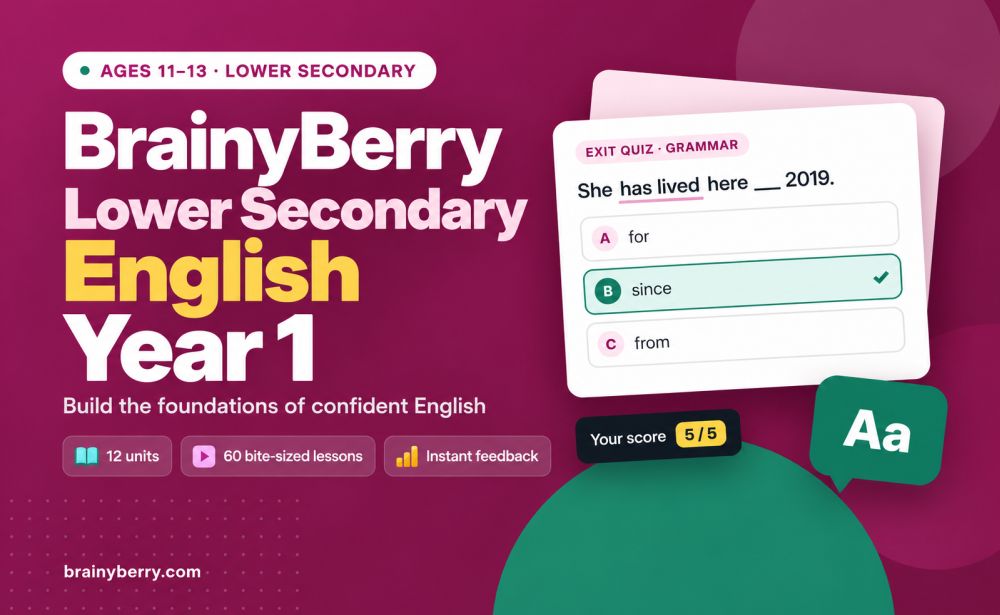
Essential English, Year 1: Build the foundations that every great communicator stands on.
Grammar that finally makes sense. Reading that sharpens your thinking. Writing that people want to read. Year 1 turns the building blocks of English into skills you can use every day, in class, in exams and beyond.
Across 12 units and 60 bite-sized lessons (10–15 minutes each), you’ll master:
- Grammar: nouns and pronouns, tenses, modals, prepositions, conjunctions and direct speech
- Vocabulary: prefixes, homophones, collocations and idioms
- Reading: stories, poems, news, biographies, play scripts and timetables
- Writing: letters, emails, reports, instructions, opinion pieces, travel writing and drama scenes
Every lesson follows the same proven path: hook, learn, worked examples, practise, apply, and an exit quiz. Instant feedback shows you exactly where you stand. Unit tests and a full end-of-year exam prove how far you’ve come.
Aligned with Cambridge Lower Secondary (Stage 7), UK Key Stage 3 (Year 7), US Common Core (Grade 6) and BECE/WAEC. That makes it ideal for learners aged 11–13 anywhere in the world.
Start Year 1 today, and watch your confidence in English grow, one lesson at a time.
If Course Builder also has a short excerpt field, here’s a one-line version:
Master grammar, vocabulary, reading and writing in 60 bite-sized lessons with instant feedback, unit tests and a final exam, built for learners aged 11–13 worldwide.
Two things to check before you publish:
- Age range: “11–13” is my assumption, matched to the curriculum levels above. Change it if you’re aiming at a different group.
- Exam names: “BECE/WAEC” is the only regional term. You could move it to the end, or drop it if you’d like a fully global pitch.
What Will You Learn?
- Use nouns, pronouns, adjectives, adverbs and articles accurately in your own writing
- Choose the right tense every time, including present perfect and future forms
- Use modals, prepositions and conjunctions to make your meaning clear and precise
- Punctuate with confidence: commas, apostrophes and direct speech
- Grow your vocabulary with prefixes, homophones, collocations and idioms
- Write strong topic sentences and well-organised paragraphs
- Read stories, poems, news, biographies and play scripts with deeper understanding
- Find facts, make inferences and compare texts like a skilled reader
- Write letters, emails, reports, instructions and opinion pieces for real audiences
- Craft vivid descriptions, travel writing and short drama scenes
- Read aloud with expression and present your ideas clearly
- Prepare for unit tests and a full end-of-year exam with instant feedback on every quiz
Course Content
Unit 1 · Nouns, Pronouns and the Topic Sentence
By the end of this unit, students can identify and use every kind of noun, choose the right pronoun, use a dictionary quickly, say the pure vowel sounds of English clearly, answer literal questions by scanning, and write a well-built paragraph that starts with a topic sentence. The theme is "Me and my world": who we are, where we live and what we love. The unit has five lessons of 10–15 minutes, a unit test with a short paragraph, and original texts.
These skills are the foundation of every lower-secondary English course and exam:
• BECE and other WAEC papers: Lexis and structure (nouns, pronouns), oral English (vowel sounds), comprehension and paragraph writing
• Cambridge Lower Secondary (Stage 7): Word classes; pronouns; using a dictionary; finding information in texts; organising writing into paragraphs
• UK Key Stage 3 (Year 7): Grammar terminology; retrieving information from a text; writing in paragraphs with accurate sentence punctuation
• US Grade 6 (Common Core): Pronoun case (L.6.1a); reference materials (L.6.4c); citing textual evidence (RI.6.1); organising ideas (W.6.2a)
Students will be able to:
• identify common, proper, countable and uncountable nouns and form plurals correctly
• use subject, object, possessive and reflexive pronouns correctly
• use alphabetical order, guide words and dictionary entries, and say short, long and schwa vowel sounds
• answer literal questions by scanning a text, in full sentences
• write complete sentences and a paragraph with a topic sentence, supporting sentences and a concluding sentence
All texts are original and written for this course. British spelling is used; US variants are noted.
-
Lesson 1 · Nouns: Name Everything
-
Lesson 1 Exit Quiz: Nouns
-
Lesson 2 · Pronouns: Words That Stand In
-
Lesson 2 Exit Quiz: Pronouns
-
Lesson 3 · Dictionary Skills and Pure Vowels: Find It, Say It
-
Lesson 3 Exit Quiz: Dictionary Skills and Pure Vowels
-
Lesson 4 · Literal Questions and Scanning: Find the Facts Fast
-
Lesson 4 Exit Quiz: Literal Questions and Scanning
-
Lesson 5 · Sentences and the Topic Sentence: Introduce Yourself
-
Lesson 5 Exit Quiz: Sentences and the Topic Sentence
-
Year 1 Unit 1 Test: Nouns, Pronouns and the Topic Sentence (Section A)
Unit 2 · Present Tenses, Agreement and Informal Letters
Unit overview
By the end of this unit, students can choose between the present simple and the present continuous, make subjects and verbs agree, use synonyms and antonyms, say tricky consonant sounds clearly, find the main idea of a text and its supporting details, and write a friendly, well-organised informal letter. The theme is "Family and community": the people we live with and the places we share. The unit has five lessons of 10–15 minutes, a unit test with an informal letter, and original texts.
These skills appear in every lower-secondary English course and exam:
• BECE and other WAEC papers: Lexis and structure (present tenses, concord, synonyms and antonyms), oral English (consonant sounds), comprehension and letter writing
• Cambridge Lower Secondary (Stage 7): Present verb forms and agreement; word meanings and relationships; main points and details in texts; writing for a familiar reader
• UK Key Stage 3 (Year 7): Standard English verb forms; vocabulary choice; summarising main ideas; writing for different purposes and audiences
• US Grade 6 (Common Core): Grammar conventions (L.6.1); word relationships (L.6.5c); central idea and details (RI.6.2); writing for task, purpose and audience (W.6.4)
Students will be able to:
• use the present simple for habits and facts and the present continuous for actions happening now
• make verbs agree with singular, plural and tricky subjects
• choose fitting synonyms and antonyms and say paired consonant sounds clearly
• identify the main idea of a text and of each paragraph, and the details that support it
• write an informal letter with the right layout, paragraphs and tone
All texts are original and written for this course. British spelling and letter conventions are used; US variants are noted.
-
Lesson 1 · Present Simple and Present Continuous: Every Day or Right Now?
-
Lesson 1 Exit Quiz: Present Simple and Present Continuous
-
Lesson 2 · Subject–Verb Agreement: Make Them Match
-
Lesson 2 Exit Quiz: Subject–Verb Agreement
-
Lesson 3 · Synonyms, Antonyms and Consonant Sounds: Choose It, Say It
-
Lesson 3 Exit Quiz: Synonyms, Antonyms and Consonant Sounds
-
Lesson 4 · Main Idea and Supporting Details: What Is It Really About?
-
Lesson 4 Exit Quiz: Main Idea and Supporting Details
-
Lesson 5 · The Informal Letter: Write to Someone You Know
-
Lesson 5 Exit Quiz: The Informal Letter
-
Year 1 Unit 2 Test: Present Tenses, Agreement and Informal Letters (Section A)
Unit 3 · Past Tenses, Prefixes and Stories
Unit overview
By the end of this unit, students can use the past simple of regular and irregular verbs correctly, use the prefixes un-, dis-, re- and mis-, identify the characters, setting, plot and moral of a folktale, put events in order, and write a short story with a clear beginning, middle and end. The theme is "Stories we tell": the folktales, fables and family stories that people share around the world. The unit has five lessons of 10–15 minutes, a unit test with a short story, and original or retold texts.
These skills appear in every lower-secondary English course and exam:
• BECE and other WAEC papers: Lexis and structure (past tenses, word formation), comprehension of narrative passages, literature (folktales) and narrative composition
• Cambridge Lower Secondary (Stage 7): Past verb forms; prefixes; plot, character and setting; structuring narrative writing
• UK Key Stage 3 (Year 7): Reading traditional tales; Standard English verb forms; planning and writing narratives
• US Grade 6 (Common Core): Affixes (L.6.4b); plot and character (RL.6.3); theme (RL.6.2); narrative writing with sequence words (W.6.3)
Students will be able to:
• use the past simple of regular verbs, with correct spelling and pronunciation of -ed
• use common irregular past forms, including was and were
• use the prefixes un-, dis-, re- and mis- to build and understand words
• identify the characters, setting, plot and moral of a folktale and put its events in order
• plan and write a short story with a beginning, a problem in the middle and an end
"Stone Soup" is a traditional folktale, and the crow fable is a very old fable; both are retold here in original words. All other texts are original. British spelling is used; US variants are noted.
-
Lesson 1 · The Past Simple (Regular Verbs): What Happened?
-
Lesson 1 Exit Quiz: The Past Simple: Regular Verbs
-
Lesson 2 · Irregular Past Verbs: Learn the Rule-Breakers
-
Lesson 2 Exit Quiz: Irregular Past Verbs
-
Lesson 3 · Prefixes: Change the Meaning in a Flash
-
Lesson 3 Exit Quiz: Prefixes
-
Lesson 4 · Folktales and Sequencing: Character, Setting and Plot
-
Lesson 4 Exit Quiz: Folktales and Sequencing
-
Lesson 5 · Writing a Story: Beginning, Middle and End
-
Lesson 5 Exit Quiz: Writing a Story
-
Year 1 Unit 3 Test: Past Tenses, Prefixes and Stories (Section A)
Unit 4 · Adjectives, Articles and Descriptive Writing
Unit overview
By the end of this unit, students can put adjectives in the right order and use them to compare, choose the right article, build words with the suffixes -ful, -less, -ness and -ment, punctuate sentences with capital letters, full stops and commas, tell facts from opinions, and write a vivid descriptive paragraph. The theme is "School life": the places, people and routines of a school day. The unit has five lessons of 10–15 minutes, a unit test with a descriptive paragraph, and original texts.
These skills appear in every lower-secondary English course and exam:
• BECE and other WAEC papers: Lexis and structure (adjectives, comparison, articles, word formation), comprehension (fact and opinion), descriptive composition and mechanical accuracy
• Cambridge Lower Secondary (Stage 7): Adjective order and comparison; articles; suffixes; distinguishing fact from opinion; descriptive writing; sentence punctuation
• UK Key Stage 3 (Year 7): Grammar and vocabulary choice; fact and opinion in non-fiction; descriptive writing; accurate punctuation
• US Grade 6 (Common Core): Grammar and punctuation conventions (L.6.1–2); distinguishing claims supported by evidence from those that are not (RI.6.8); precise words and sensory language (W.6.3d)
Students will be able to:
• put adjectives in the correct order and form comparatives and superlatives correctly
• choose a, an, the or no article correctly
• build adjectives and nouns with -ful, -less, -ness and -ment, and punctuate sentences with capital letters, full stops and commas
• tell facts from opinions and spot opinion signal words
• write a descriptive paragraph using the senses, precise adjectives and strong verbs
All texts are original and written for this course. British spelling is used; US variants are noted.
-
Lesson 1 · Adjectives: Put Them in Order, Compare Them Well
-
Lesson 1 Exit Quiz: Adjectives: Order and Comparison
-
Lesson 2 · Articles: A, An, The or Nothing?
-
Lesson 2 Exit Quiz: Articles
-
Lesson 3 · Suffixes and Sentence Punctuation: -ful, -less, -ness, -ment
-
Lesson 3 Exit Quiz: Suffixes and Punctuation
-
Lesson 4 · Fact and Opinion: Can You Prove It?
-
Lesson 4 Exit Quiz: Fact and Opinion
-
Lesson 5 · The Descriptive Paragraph: Paint a Picture With Words
-
Lesson 5 Exit Quiz: The Descriptive Paragraph
-
Year 1 Unit 4 Test: Adjectives, Articles and Descriptive Writing (Section A)
Unit 5 · Adverbs, Collocations and Instructions
Unit overview
By the end of this unit, students can use adverbs of manner, time, place and frequency correctly, choose the right verb in common collocations with make, do, have and take, read a recipe and follow its steps, listen to spoken instructions and make notes, and write clear, safe instructions of their own. The theme is "Food and health": cooking, eating well and staying safe. The unit has five lessons of 10–15 minutes, a unit test with a set of instructions, and original texts. Lesson 4 includes a talk that the lesson page reads aloud.
These skills appear in every lower-secondary English course and exam:
• BECE and other WAEC papers: Lexis and structure (adverbs, collocations), comprehension of practical texts, oral English (listening) and writing instructions
• Cambridge Lower Secondary (Stage 7): Adverbs; collocation; reading and writing instructions; listening for key information
• UK Key Stage 3 (Year 7): Standard English; reading non-fiction for information; writing to instruct; listening and spoken language
• US Grade 6 (Common Core): Grammar conventions (L.6.1); word relationships (L.6.5); text structure (RI.6.5); interpreting information presented orally (SL.6.2); informative writing (W.6.2)
Students will be able to:
• use adverbs of manner, time, place and frequency, with correct spelling and word order
• use common collocations with make, do, have and take
• read a procedural text and follow its steps in order
• listen to spoken instructions and make short, useful notes
• write clear instructions with a title, a list, numbered steps, imperative verbs and a safety tip
All texts are original and written for this course. British spelling is used; US variants are noted.
-
Lesson 1 · Adverbs: How, When, Where and How Often
-
Lesson 1 Exit Quiz: Adverbs
-
Lesson 2 · Collocations: Make, Do, Have and Take
-
Lesson 2 Exit Quiz: Collocations
-
Lesson 3 · Procedural Texts: Follow the Steps
-
Lesson 3 Exit Quiz: Procedural Texts
-
Lesson 4 · Listening to Instructions: Hear It, Do It
-
Lesson 4 Exit Quiz: Listening to Instructions
-
Lesson 5 · Writing Instructions: Clear Steps, Safe Results
-
Lesson 5 Exit Quiz: Writing Instructions
-
Year 1 Unit 5 Test: Adverbs, Collocations and Instructions (Section A)
Unit 6 · Prepositions, Homophones and Reports
Unit overview
By the end of this unit, students can use prepositions of place and time correctly, choose the right homophone (there, their, they're; its, it's and more), use headings to find information in an information text, spell plurals and word endings by pattern, and write a short report with subheadings. The theme is "Animals and nature": wildlife, habitats and the natural world. The unit has five lessons of 10–15 minutes, a unit test with a short report, and original texts.
These skills appear in every lower-secondary English course and exam:
• BECE and other WAEC papers: Lexis and structure (prepositions), spelling and homophones, comprehension of factual texts and report writing
• Cambridge Lower Secondary (Stage 7): Prepositions; spelling patterns and homophones; reading non-fiction for information; writing reports
• UK Key Stage 3 (Year 7): Standard English and accurate spelling; reading non-fiction; writing to inform
• US Grade 6 (Common Core): Grammar conventions (L.6.1); spelling (L.6.2b); text structure and features (RI.6.5); informative writing with headings (W.6.2a)
Students will be able to:
• use prepositions of place and time accurately
• tell common homophones apart and spell them correctly
• use headings and subheadings to find information quickly
• spell plurals and words with -ing and -ed endings by pattern
• write a short report with a title, an opening, subheadings, facts and a conclusion
All texts are original and written for this course. British spelling is used; US variants are noted.
-
Lesson 1 · Prepositions of Place and Time: In, On, At and More
-
Lesson 1 Exit Quiz: Prepositions
-
Lesson 2 · Homophones: Same Sound, Different Word
-
Lesson 2 Exit Quiz: Homophones
-
Lesson 3 · Information Texts: Headings That Help
-
Lesson 3 Exit Quiz: Information Texts
-
Lesson 4 · Spelling Patterns: Plurals, Endings and Silent Letters
-
Lesson 4 Exit Quiz: Spelling Patterns
-
Lesson 5 · Writing a Short Report: Facts in the Right Places
-
Lesson 5 Exit Quiz: Writing a Report
-
Year 1 Unit 6 Test: Prepositions, Homophones and Reports (Section A)
Unit 7 · Conjunctions, Idioms, Biography and Poetry
Unit overview
By the end of this unit, students can join ideas into compound sentences with coordinating conjunctions, understand and use common idioms, read a biography and make inferences supported by evidence, write a biographical paragraph in chronological order, and identify rhyme, rhythm, simile, metaphor and personification in a poem. The theme is "Heroes and role models": real people who changed the world and everyday heroes close to home. The unit has five lessons of 10–15 minutes, a unit test with a biographical paragraph, a biography of Wangari Maathai, a model paragraph about Marie Curie and an original poem.
These skills appear in every lower-secondary English course and exam:
• BECE and other WAEC papers: Lexis and structure (conjunctions, idioms), comprehension with inference questions, literature (poetry terms) and composition
• Cambridge Lower Secondary (Stage 7): Compound sentences; idiomatic language; inference; biography; poetic devices
• UK Key Stage 3 (Year 7): Grammar for writing; reading non-fiction and poetry; figurative language; writing to inform
• US Grade 6 (Common Core): Sentence variety (L.6.3); figurative language (L.6.5); citing evidence for inferences (RI.6.1); poetry structure (RL.6.5); informative writing (W.6.2)
Students will be able to:
• join two main clauses with a comma and a coordinating conjunction
• understand and use common idioms, and know when they are too informal
• make inferences about a real person and support them with evidence
• write a biographical paragraph with a topic sentence, events in time order and a conclusion
• identify rhyme, rhythm, simile, metaphor and personification, and comment on their effect
The biography and model paragraphs are written for this course from well-known facts; the poem is original. British spelling is used; US variants are noted.
-
Lesson 1 · Conjunctions and Compound Sentences: Joining Ideas
-
Lesson 1 Exit Quiz: Conjunctions
-
Lesson 2 · Idioms: When Words Don’t Mean What They Say
-
Lesson 2 Exit Quiz: Idioms
-
Lesson 3 · Biography and Inference: Reading Between the Lines
-
Lesson 3 Exit Quiz: Biography and Inference
-
Lesson 4 · Writing a Biographical Paragraph: A Life in Order
-
Lesson 4 Exit Quiz: Biographical Paragraph
-
Lesson 5 · Poetry Basics: Rhyme, Rhythm, Simile and Metaphor
-
Lesson 5 Exit Quiz: Poetry Basics
-
Year 1 Unit 7 Test: Conjunctions, Idioms, Biography and Poetry (Section A)
Unit 8 · Present Perfect, Comparing Texts and Informal Emails
Unit overview
By the end of this unit, students can use the present perfect for experiences and recent events (and know when to use the past simple instead), recognise common loanwords and where they come from, compare two texts on the same topic, write a lively informal email describing an event, and place the stress correctly in common words. The theme is "Celebrations and festivals" from around the world. The unit has five lessons of 10–15 minutes, a unit test with an informal email, and original texts.
These skills appear in every lower-secondary English course and exam:
• BECE and other WAEC papers: Lexis and structure (tenses), oral English (word stress), comprehension and informal letter or email writing
• Cambridge Lower Secondary (Stage 7): Present perfect; word origins; comparing texts; writing for a friendly audience; spoken clarity
• UK Key Stage 3 (Year 7): Standard English grammar; etymology; comparing texts; writing for different audiences and purposes
• US Grade 6 (Common Core): Verb tenses (L.6.1); word origins and pronunciation (L.6.4); comparing texts (RI.6.9); narrative writing (W.6.3); audience and register (W.6.4)
Students will be able to:
• use the present perfect with ever, never, just, already, yet, for and since
• choose between the present perfect and the past simple
• recognise common loanwords and the languages they come from
• compare two texts using both, whereas and while
• write an informal email describing an event, and stress common words correctly
All texts are original and written for this course. British spelling is used; US variants are noted.
-
Lesson 1 · The Present Perfect: Have You Ever…?
-
Lesson 1 Exit Quiz: Present Perfect
-
Lesson 2 · Loanwords: English Words From Around the World
-
Lesson 2 Exit Quiz: Loanwords
-
Lesson 3 · Comparing Two Texts: Same Topic, Different Voices
-
Lesson 3 Exit Quiz: Comparing Texts
-
Lesson 4 · Writing an Informal Email: Tell Me All About It
-
Lesson 4 Exit Quiz: Informal Email
-
Lesson 5 · Word Stress: Which Syllable Is Strongest?
-
Lesson 5 Exit Quiz: Word Stress
-
Year 1 Unit 8 Test: Present Perfect, Comparing Texts and Informal Emails (Section A)
Unit 9 · Future Forms, News and Opinion Writing
Unit overview
By the end of this unit, students can talk about the future with will, be going to and the present continuous, ask correct questions and add question tags, work out how compound, clipped and blended words are made, read a news article and find the 5 Ws, and write a clear opinion paragraph using the OREO plan. The theme is "Technology and the future": phones, robots, inventions and how we will live. The unit has five lessons of 10–15 minutes, a unit test with an opinion paragraph, and original texts.
These skills appear in every lower-secondary English course and exam:
• BECE and other WAEC papers: Lexis and structure (future forms, question tags, word formation), comprehension and argumentative composition
• Cambridge Lower Secondary (Stage 7): Future forms; question forms; word formation; reading news reports; writing to argue
• UK Key Stage 3 (Year 7): Standard English grammar; reading non-fiction including journalism; writing to argue and persuade
• US Grade 6 (Common Core): Grammar conventions (L.6.1); word parts and meaning (L.6.4); citing evidence (RI.6.1); text structure (RI.6.5); argument writing (W.6.1)
Students will be able to:
• talk about predictions, plans and arrangements with the right future form
• form correct questions and question tags
• explain how compound, clipped and blended words are made
• find the 5 Ws in a news article and tell facts from quoted opinions
• write an opinion paragraph with reasons, an example and a conclusion
All texts are original and written for this course. British spelling is used; US variants are noted.
-
Lesson 1 · Talking About the Future: Will or Going To?
-
Lesson 1 Exit Quiz: Future Forms
-
Lesson 2 · Questions and Question Tags: Ask It Right
-
Lesson 2 Exit Quiz: Questions and Tags
-
Lesson 3 · Compound, Clipped and Blended Words: How New Words Are Made
-
Lesson 3 Exit Quiz: New Words
-
Lesson 4 · Reading a News Article: Who, What, Where, When, Why?
-
Lesson 4 Exit Quiz: News Articles
-
Lesson 5 · Writing an Opinion Paragraph: Say It and Prove It
-
Lesson 5 Exit Quiz: Opinion Paragraph
-
Year 1 Unit 9 Test: Future Forms, News and Opinion Writing (Section A)
Unit 10 · Modals, Commas, Timetables and Travel Writing
Unit overview
By the end of this unit, students can use can, could and may for ability, permission and polite requests, place commas correctly, read timetables and leaflets quickly, follow spoken directions, and write a lively travel blog post. The theme is "Travel and places": journeys, cities and finding your way. The unit has five lessons of 10–15 minutes, a unit test with a travel blog post, and original texts. Lesson 4 includes a set of directions that the lesson page reads aloud.
These skills appear in every lower-secondary English course and exam:
• BECE and other WAEC papers: Lexis and structure (modals), punctuation, comprehension of practical texts, oral English (listening) and composition
• Cambridge Lower Secondary (Stage 7): Modal verbs; commas; reading non-continuous texts; listening for detail; recount writing
• UK Key Stage 3 (Year 7): Standard English and punctuation; reading information texts; spoken language; writing to describe and recount
• US Grade 6 (Common Core): Grammar and punctuation conventions (L.6.1, L.6.2); integrating visual information (RI.6.7); following oral information (SL.6.2); narrative writing (W.6.3)
Students will be able to:
• use can, could and may for ability, permission and polite requests
• use commas in lists, after introductory phrases, in compound sentences and with names
• find times, prices and rules in a timetable or leaflet
• follow spoken directions and make clear route notes
• write a travel blog post with a hook, subheadings, sensory detail and a tip
All texts are original and written for this course. British spelling is used; US variants are noted.
-
Lesson 1 · Can, Could and May: Ability, Permission and Polite Requests
-
Lesson 1 Exit Quiz: Can, Could and May
-
Lesson 2 · Commas: Small Mark, Big Difference
-
Lesson 2 Exit Quiz: Commas
-
Lesson 3 · Timetables and Leaflets: Read the Information Fast
-
Lesson 3 Exit Quiz: Timetables and Leaflets
-
Lesson 4 · Listening to Directions: Find Your Way
-
Lesson 4 Exit Quiz: Listening to Directions
-
Lesson 5 · Writing a Travel Blog: Take Your Reader With You
-
Lesson 5 Exit Quiz: Travel Blog
-
Year 1 Unit 10 Test: Modals, Commas, Timetables and Travel Writing (Section A)
Unit 11 · Direct Speech, Characters and Drama
-
Lesson 1 · Direct Speech: Punctuate the Talking
-
Lesson 1 Exit Quiz: Direct Speech
-
Lesson 2 · Character Words and “Show, Don’t Tell”: Bring People to Life
-
Lesson 2 Exit Quiz: Show, Don’t Tell
-
Lesson 3 · Reading a Play Script: Words, Actions and Stage Directions
-
Lesson 3 Exit Quiz: Play Scripts
-
Lesson 4 · Reading Aloud With Expression: Bring the Words to Life
-
Lesson 4 Exit Quiz: Reading Aloud
-
Lesson 5 · Writing a Play Scene: Characters, Conflict and Stage Directions
-
Lesson 5 Exit Quiz: Writing a Play Scene
-
Year 1 Unit 11 Test: Direct Speech, Characters and Drama (Section A)
Unit 12 · Year 1 Review and End-of-Year Exam
Unit overview
This unit brings Year 1 together. Lessons 1–4 review the year: the most common grammar errors from Units 1–11, the vocabulary toolkit, unseen comprehension, and timed writing. Lesson 5 is the end-of-year exam, with a timed, self-marking objective paper and a writing paper with a model answer and marking guide.
The exam follows the format used in most lower-secondary English exams, so it doubles as practice for:
• BECE and other WAEC papers: Objective test (lexis and structure, spelling and punctuation, comprehension, literature terms) and continuous writing
• Cambridge Lower Secondary (Stage 7): Reading fiction and non-fiction, grammar and vocabulary in context, and writing for different purposes
• UK Key Stage 3 (Year 7): End-of-year assessments in reading, grammar, vocabulary and writing
• US Grade 6 (Common Core): Conventions (L.6.1–2), vocabulary (L.6.4–5), reading literature and informational texts (RL/RI.6.1–4) and writing (W.6.1–3)
Students will be able to:
• find and correct the most common grammar errors from the year
• use prefixes, suffixes, collocations, idioms and context clues to understand and choose words
• answer literal, inference, vocabulary and language questions on an unseen passage
• plan, write and check a piece of writing in 30 minutes
• sit a full end-of-year exam and use the results to plan revision
All passages are original and written for this course. Both passages are about real places and people (the coast redwoods of California and William Kamkwamba's windmill in Malawi). British spelling is used; US variants are noted.
-
Lesson 1 · Grammar Rescue: Spot It, Fix It
-
Lesson 1 Exit Quiz: Grammar Rescue
-
Lesson 2 · Word Power Review: Build, Choose and Guess Words
-
Lesson 2 Exit Quiz: Word Power
-
Lesson 3 · Unseen Comprehension: Read, Think, Answer
-
Lesson 3 Exit Quiz: Unseen Comprehension
-
Lesson 4 · Timed Writing: Plan, Write and Check in 30 Minutes
-
Lesson 4 Exit Quiz: Timed Writing
-
Lesson 5 · End-of-Year Exam: Show What You Know
-
Year 1 End-of-Year Exam, Paper 1